It depends on where you are. At the Sacred Monkey Forest in Ubud, feeding is banned and food may not be brought in; at Sangeh, management has sold official feed for visitors to hand out since January 2024; at Pura Luhur Uluwatu, outside food is the main trigger for snatched belongings. Wherever you are, one bite means a trip to a clinic that same day, because Bali still has rabies: the Bali Provincial Health Office recorded 45,365 bites by rabies-carrying animals and seven deaths in January-August 2026 (ANTARA, 13 August 2026).
What are the rules at Ubud's Sacred Monkey Forest?
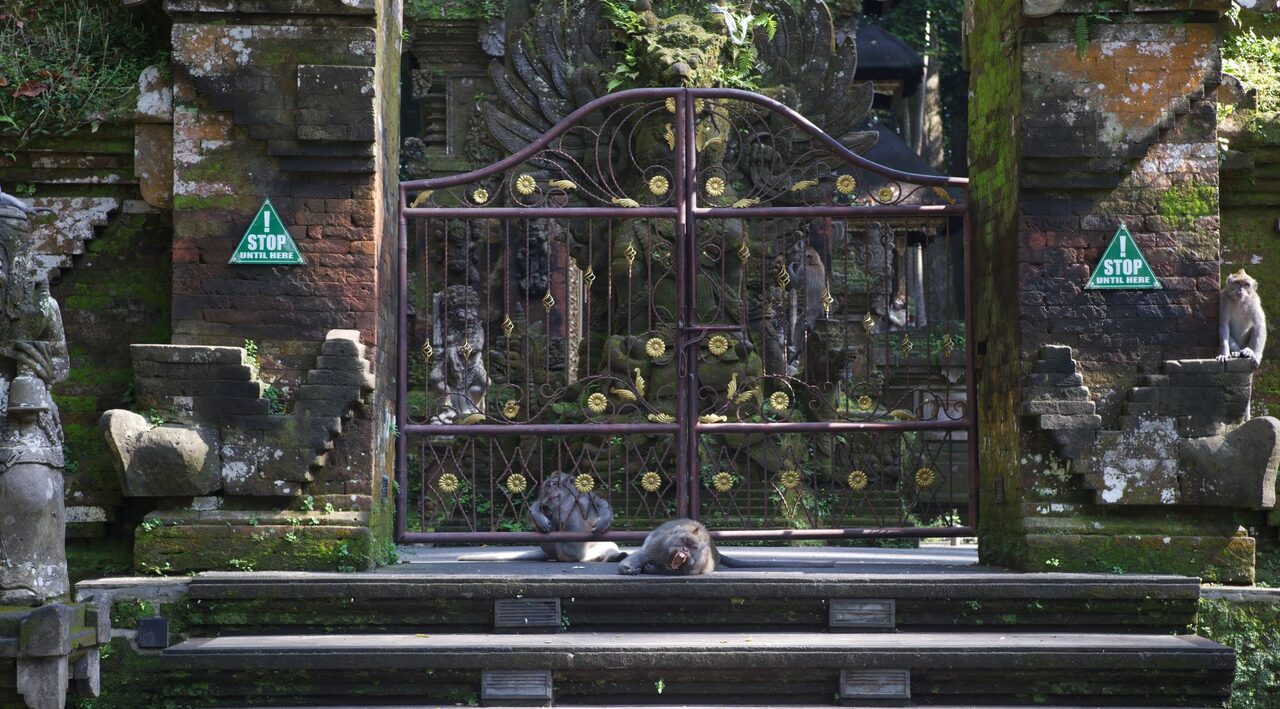
The official Guidelines & FAQ page on monkeyforestubud.com (checked October 2026) says: no food or drinks in the forest, no feeding or interacting unless directly supervised by staff, and peanuts are specifically banned for the monkeys' health. Staff feed the monkeys nine times a day, mainly sweet potato. Plastic bags are not allowed either; lockers are available in the lobby. Management states that incidents outside the guidelines are at the visitor's own risk. Listed entry is IDR 130,000 for adults and IDR 100,000 for children, open 09.00-18.00 with last entry at 17.00.
Can you feed the monkeys at Sangeh?
Yes, with feed from the management. According to detikBali (2 August 2026), the foreign adult ticket of IDR 75,000 and child ticket of IDR 50,000 include bottled water and monkey food; the domestic ticket of IDR 15,000 does not include feed. Bananas and edamame are sold separately for IDR 20,000. Staff feed about 700 monkeys at 06.00 and 11.00 WITA. We found no written rule on outside food, but the official feed is a safer choice than peanuts or bread brought from outside.
What about Uluwatu?
The monkeys at Pura Luhur Uluwatu are famous for grabbing glasses, hats, phones and sandals, then releasing them in exchange for food. A study by the University of Lethbridge and Udayana University (published 2021) recorded 201 rob-and-barter events and found that adult monkeys held out for more food when the item was more valuable. A handler coordinator quoted by international media in 2025 said the behaviour grew after management banned tourists from feeding and took over feeding itself. So do not carry open food and do not try to bargain yourself; call a handler or staff member. We found no official rate for a handler's help, so ask before they start.
And Alas Kedaton in Tabanan?
Management provides daily feed, plus special fruit at the Tumpek Kandang ceremony (Mongabay). We found no current written rule on visitors feeding, and reviews describe the monkeys here as generally calm unless they see food. Follow the local guides at the gate; tickets and atmosphere are covered in our Alas Kedaton Tabanan article.
Is there a fine?
We found no regional regulation or official notice setting a specific fine for feeding monkeys at any of these four sites (checked October 2026). The consequences are more practical: a warning or being asked to leave by staff, losing your belongings, or a bite at your own risk.
How real is the rabies risk from monkeys?
Indonesia's Ministry of Health classes monkeys as rabies-carrying animals alongside dogs and cats, although most rabies cases in Indonesia come from dogs. The Monkey Forest says 14 years of research in Bali has not found rabies in monkeys, and its monkeys' health is monitored by Udayana University's Primate Research Center. That is good news, but not a reason to delay a check: whether you need rabies vaccine is a decision for a health worker. The US Centers for Disease Control (CDC) also warns about herpes B virus from macaque bites or scratches.
What to do if you are bitten or scratched
- Wash the wound with soap under running water for 15 minutes.
- Report to the on-site first-aid clinic; the Ubud Monkey Forest has a clinic with a nurse.
- Go to a puskesmas (community clinic), hospital or rabies centre the same day. Keep a photo of the wound and note the place and time.
The full steps, including the injection schedule, are in Bitten by a Monkey or Dog in Bali? The Right Rabies Steps.
Before you walk into monkey territory
- Put glasses, hats, earrings and phones in a closed bag. Plastic bags and small shiny objects attract attention.
- Do not stare a monkey in the eye. If one jumps on you, do not run; stand calmly, then walk away slowly.
- Watch your children. The Monkey Forest specifically asks parents to keep children from playing with the monkeys.
- Never wrestle a monkey for an item. A phone can be replaced; a bite means a course of injections.
Sources used: official guidelines at monkeyforestubud.com, detikBali 2 August 2026 (Sangeh), ANTARA 13 August 2026 (bite data), Mongabay (Alas Kedaton), and Leca et al., Philosophical Transactions of the Royal Society B, 2021 (Uluwatu).





Bình luận 0
Chưa có bình luận nào. Hãy là người đầu tiên bình luận!