Yes. Bali Governor's Circular No. 7 of 2025 makes prayer the only reason a foreign tourist may enter a temple's Utamaning Mandala and Madyaning Mandala, on condition that you wear Balinese traditional dress and are not menstruating. On the ground, the temple priest (pemangku) and the customary village that runs the temple still have the final say, so ask before you sit down among worshippers.
The question comes up a lot from Japanese and Korean visitors who are used to praying at shrines and temples when they travel. A Balinese pura has three courtyards: jaba sisi (the outer yard), jaba tengah (the middle yard, madya mandala) and jeroan (the inner sanctum, utama mandala). The outer yard is usually open to visitors wearing a sarong. The two inner yards are places of worship, and that is where the prayer rule applies.
What exactly does the rule say?
Circular No. 7/2025 on conduct for foreign tourists was announced by Governor Wayan Koster on 24 March 2025 and refines Circular No. 4/2023. It requires visitors to "honour the sanctity of temples, pratima and sacred religious symbols", to dress in a way that is "polite, reasonable and appropriate, especially when visiting holy places", and it bans entry to the Utamaning and Madyaning Mandala "except for the purpose of praying while wearing Balinese traditional dress and not menstruating".
Note that the circular says nothing about religion. It regulates purpose and manner: you enter to pray, in traditional dress, in a state of ritual purity. Walking into the inner sanctum just for photos is still banned, even if you are fully dressed.
This is not new in practice. During Galungan in 2019, Antara reported a Polish couple praying at Pura Dalem Ubud, the man in white with an udeng headcloth and the woman in a kebaya. The temple's priest said most of the people praying that day were not Hindu and that local worshippers welcomed them.
Before you join a prayer: common mistakes
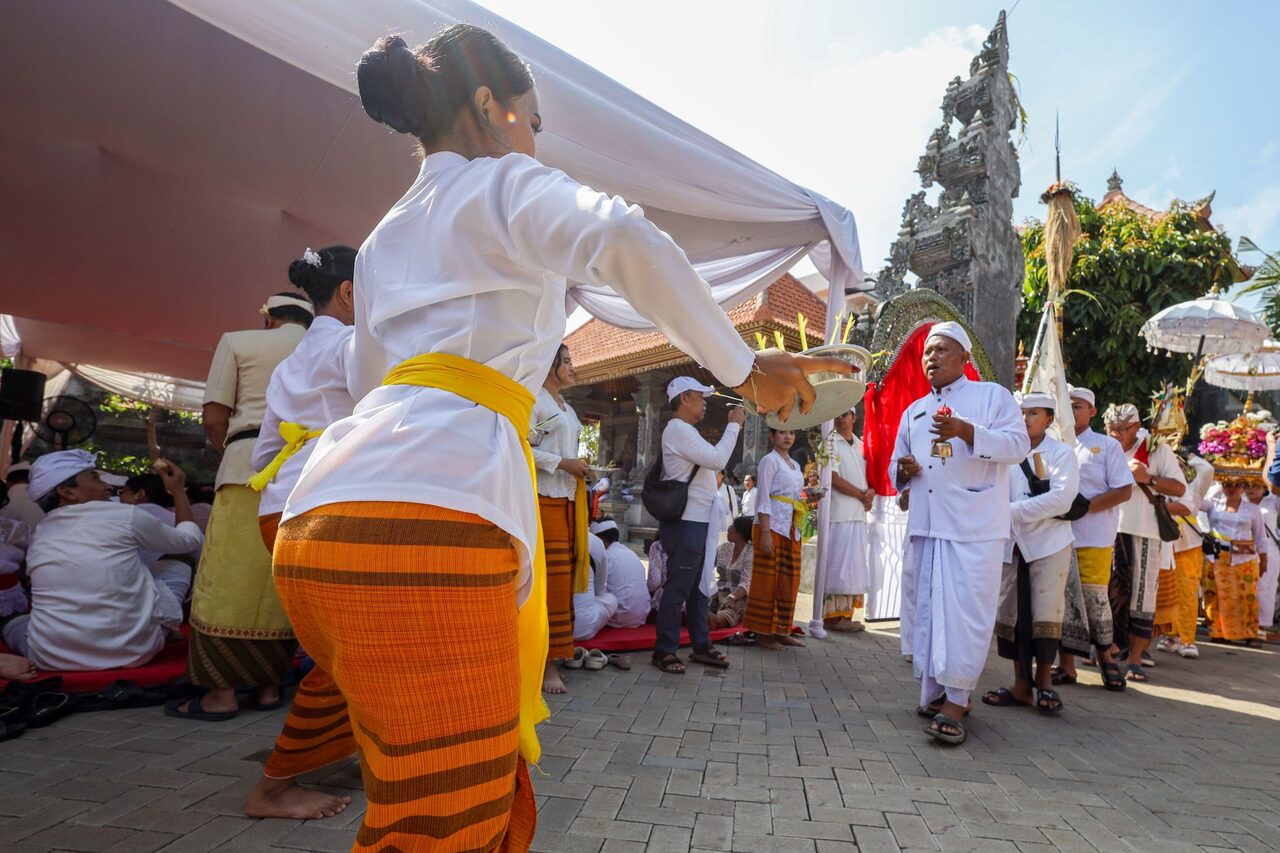
- Assuming a rented sarong is enough. The sarong and sash from the ticket desk are fine for the outer yard. To enter as a worshipper (pemedek), wear traditional dress: a kamen wrap, a selendang or senteng sash at the waist, a shirt or kebaya, and an udeng for men. Sizes and colours are covered in our article on temple dress rules.
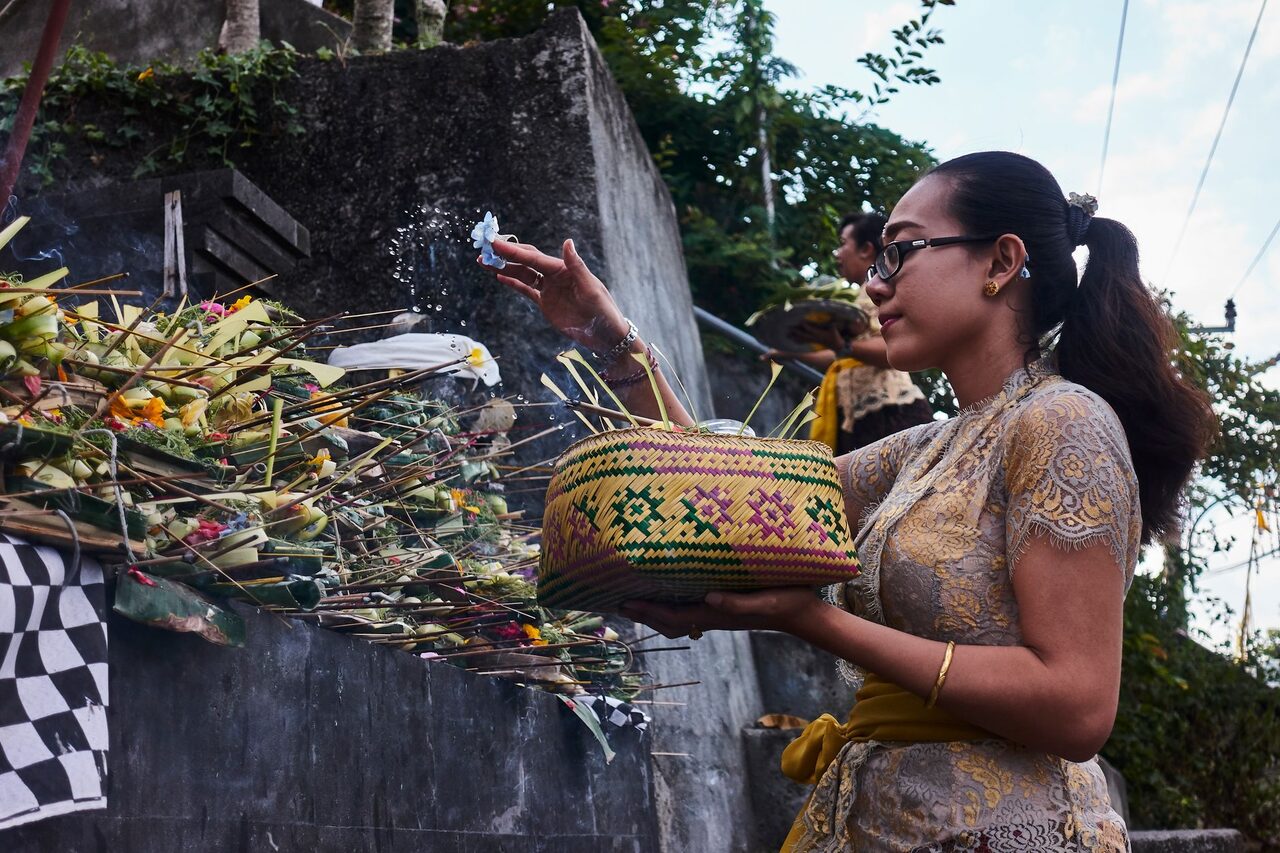
- Arriving empty-handed. Bring a canang sari offering, incense and flowers for the prayer. At big temples, stalls near the car park sell canang and pejati offerings, for example at Tirta Empul.
- Not greeting the priest. Tell the pemangku you would like to join the prayer (muspa). The priest or a pecalang (village guard) will show you where to sit, usually at the back, and when to start.
- Coming while cuntaka. Women who are menstruating or have recently given birth, and anyone in mourning after a death in the family, are considered ritually impure (cuntaka) and do not enter the inner yards. More detail in our article on menstruation and temples.
- Photographing people at prayer from the front. Put your phone away during the prayer. If you want a photo, ask afterwards and shoot from behind.
- Sitting the wrong way. Face the shrine like everyone else. Men sit cross-legged, women kneel with legs tucked to the side, and never sit higher than the priest.
- Turning up at the peak of a temple festival. During an odalan the inner yard is packed from early morning and prayers run in waves. An ordinary day is far easier for a first-timer. Ask the temple management about the odalan date before you go.
What is the order of prayer?
Balinese Hindus use the kramaning sembah, or panca sembah: five acts of worship with both palms pressed together in front of the forehead.
- First, with empty hands (sembah puyung).
- Second, holding a flower, to Sang Hyang Widhi as Siwa Raditya.
- Third, with a flower or kwangen, to the deity of that temple (Ista Dewata).
- Fourth, with a flower or kwangen, asking for blessings.
- Fifth, again with empty hands.
The priest then sprinkles tirta (holy water). Cup your right hand over your left, sip three times, then wipe it over your face. Finally, press a few grains of wet rice (bija) onto your forehead. You do not need to know any mantras; just follow the person next to you. If you are not comfortable making the gestures, sitting quietly and respectfully is also accepted.
How is it different at Tirta Empul and Besakih?
At Pura Tirta Empul in Tampaksiring, visitors may do melukat (ritual purification) in the spring-fed pools after buying an entry ticket. The rules are strict: wear a sarong, no soap or shampoo, no cameras in the pool, and no entry for women who are menstruating or postpartum. Guides there usually suggest starting at the spout on the far left. The inner courtyard behind the pools is a prayer space, not a photo spot. Step-by-step details are in our Tirta Empul melukat guide.
At Pura Besakih, the provincial government has since 2019 been reorganising the complex so tourists view the temple from lookout points instead of wandering into sacred areas. Under Circular 7/2025, if you come to pray in traditional dress with offerings you may still go further in; bring a local guide or ask a priest on site for direction. Tickets, sarong rental and donations vary by temple, explained in our article on temple donations.
One last tip: for your first time, pick a small neighbourhood temple near where you stay and ask your homestay owner or a Hindu staff member at your hotel whether you can join them when they pray. Going with a local is far easier than walking into a crowded major temple on your own.
FAQ
Do I have to be Hindu to join a prayer? No. Circular 7/2025 does not require any religion, only the purpose of praying, Balinese traditional dress and not menstruating. The priest still decides who sits where.
What happens if I enter the inner sanctum just to take photos? That breaks the circular's ban, and Governor Koster has said the rules are strictly enforced. Staff or pecalang will ask you to leave. Other visitor rules are on our Bali rules page.
Can I join prayers during Galungan? Yes, under the same conditions. Temples get very crowded, so go with local people and follow their line.
Sources: Bali Governor's Circular No. 7/2025 via Antara Bali (24 March 2025) and CNA Indonesia (7 April 2025); Antara Bali on foreign tourists praying at Galungan in Ubud (2019); Antara Bali on restricting tourists at Pura Besakih (2019); Good News From Indonesia on melukat rules at Tirta Empul (2024) (checked 27 November 2026).


Kommentare 0
Noch keine Kommentare. Schreiben Sie den ersten!